Revenue is discovered after the fact
The month's production is established at month end, by cross-referencing timesheets, contracts and rates. The result arrives too late to be corrected.
This is the domain where days become euros. Production is calculated automatically, from what has already been entered upstream — then a human decides what gets invoiced.

In most organisations, rebuilding what needs to be invoiced is a manual, monthly exercise, redone identically every time.
The month's production is established at month end, by cross-referencing timesheets, contracts and rates. The result arrives too late to be corrected.
Work is delivered but not yet invoiced, without anyone knowing exactly how much. WIP is measured once a year, at year-end inventory.
The same amounts are re-typed into the accounting tool. Every re-entry is a chance for a gap between steering and the accounts.
The first module produces the amounts. The second is where a person approves what goes to the client. The third measures what has been produced but not yet invoiced. The fourth spares anyone from re-typing them.
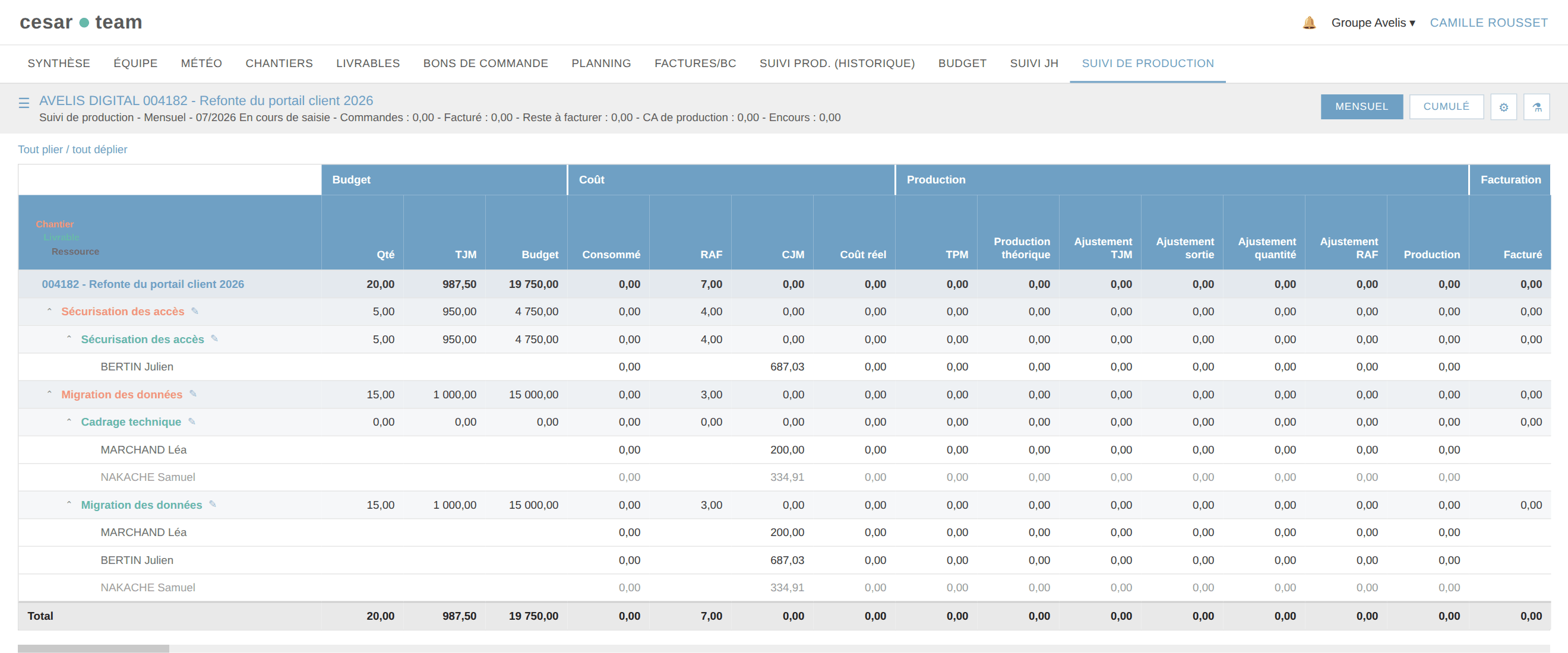
Budget, cost, production and invoicing at every level of the tree, in monthly or cumulative view. It is the reference screen for management control — it has its own detailed page.
Approval of the amounts to invoice per client, according to the engagement model: time & materials, fixed price or subscription. Nothing goes out automatically: the platform proposes, the manager decides.
Production delivered minus amounts invoiced: remaining to invoice can be read continuously, and the close derives accrued and deferred income from it. WIP stops being a year-end estimate and becomes a monthly figure.
Approved amounts feed the accounting system without re-keying. Steering and the accounts tell the same story, with the same figures.
Everything the calculation needs has already been entered elsewhere: the envelope in domain 01, the breakdown in 02, the days in 03. This domain asks for nothing new — it assembles.
The deliverable's days are multiplied by the current daily rate. That amount is the period's production.
The same days, valued at the resources' average daily cost, plus external expenses attached to the deliverable.
Production minus cost, from deliverable up to project. No level is a total recalculated separately: everything rolls up from the same base.
Orders, invoiced, remaining to invoice, production revenue and WIP are displayed above the table, at any point in the month. That is the permanent reading; the WIP module then derives the closing entries from it.
The same client may fall under several models depending on the deal. What changes is what triggers the amount — not the way it is approved or transmitted.
In all three cases, the manager sees the proposed amount, adjusts it if needed, and approves it client by client. It is this approval — and it alone — that makes the amount billable and passes it downstream.
At month end, part of the work delivered has no invoice against it yet — and part of the invoices issued has no work against it yet. These two gaps have a name on the balance sheet: accrued income on one side, deferred income on the other. They determine the period's result, and they are what your statutory auditor will come to check.
The module calculates them deal by deal, continuously, from the same data as production tracking — no restatement, no extraction, no assumptions. WIP stops being a year-end estimate rebuilt once a year in a spreadsheet: it becomes a monthly figure, and the close stops being a catch-up exercise.

The three counters at the top are read together: total WIP is the net balance of the portfolio, accrued income the share already produced that remains to be invoiced, deferred income the share already invoiced that remains to be produced. Each row of the table carries the same calculation at deal level.
The last step of the chain is also the one that determines the credibility of everything else: if the accounts and steering diverge, it is steering that people stop believing.
What is transmitted is exactly what was approved in the platform. No intermediate entry happens between the two.
Each amount stays attached to its project, workstream and deliverable. You can trace an entry back to the day recorded that produced it.
Invoiced amounts come back into production tracking and feed the next period's remaining to invoice.
Tell us how many days today separate the end of a month from your invoices being issued, and through how many hands the amounts pass. We will run the same process in CESAR.