A ready-to-use project template
The usual phases, workstreams and deliverables of the business are pre-configured. You instantiate the template when the deal starts; the breakdown does not have to be reinvented.
The breakdown is what makes the margin calculable. A badly structured project produces figures that are right in total and wrong everywhere else — and nobody notices before the close.

Structuring a deal from scratch means weeks of configuration — and two comparable projects that, lacking a common framework, no longer look alike. CESAR does the opposite: every project starts from a ready-to-use template, pre-configured by business, that you instantiate and then adjust.
The usual phases, workstreams and deliverables of the business are pre-configured. You instantiate the template when the deal starts; the breakdown does not have to be reinvented.
The project starts from the framework. You change what is specific to the deal and keep the rest — instead of starting from a blank page with every new order.
Two projects from the same template have the same breakdown. Their margin variances become interpretable, and every deal improves the next template.
Setting milestones is not enough to keep a deal on track. The schedule assigns each resource to a deliverable according to its availability rate — the time actually available once leave, other projects and recurring tasks are deducted. This granularity is what separates a planned workload from wishful thinking.
A resource assigned beyond their availability is not an alert: it is the cause of a delay you will only see at the close. The schedule consolidates workload by resource and by project, and brings the conflict to light before it costs anything.
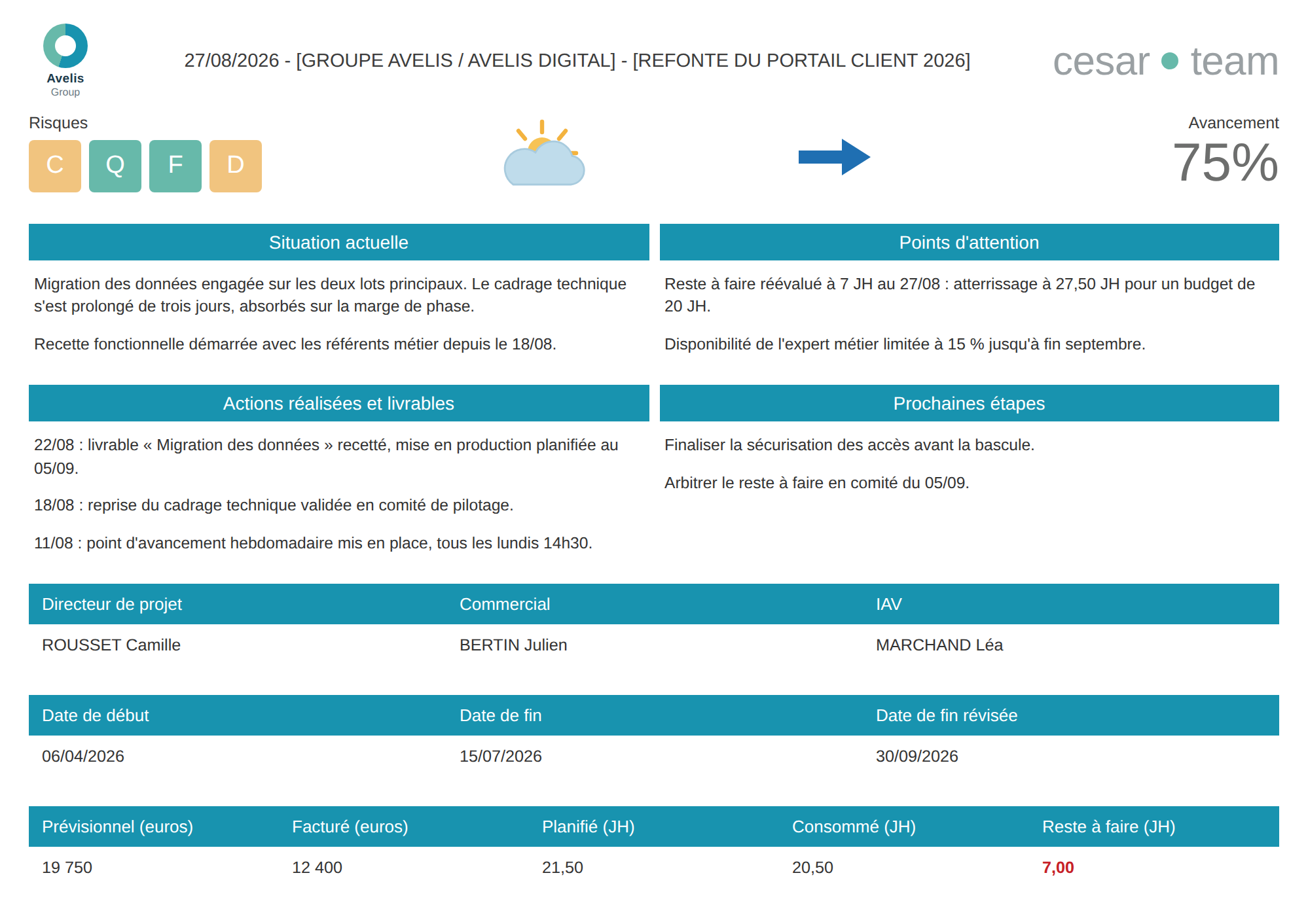
Once the deal is under way, steering does not mean watching a chart. It means holding three lines at once — what is produced, what threatens the deal, and what must be delivered on time — from the same breakdown as the budget.
Progress is measured by deliverables produced, not by time spent. Estimate to complete and budget variance can be read continuously, at every level of the tree. “Busy” is no longer mistaken for “progressing”.
Each risk is identified, rated and attached to a workstream. When it materialises, its impact on the margin at completion is already quantified — the decision is made on an amount, not on a hunch.
Milestones and dependencies are held in the single breakdown. A slipping date carries its effect through to resource workload and the billing schedule, without re-keying.
A dedicated module carries the contract type of each deal. Each one has its own revenue recognition and invoicing rules — CESAR applies them without re-keying and consolidates WIP, margin and cash whatever the model.
Revenue recognised on percentage of completion, estimate to complete tracked by deliverable, accrued and deferred income calculated at the close. Margin at completion stays under control, even when time spent overruns the price sold.
Valuation of recorded person-days, caps and recharging tracked continuously. Workload overrun becomes visible before it exceeds the ordered envelope.
Recurring revenue spread over the schedule, MRR and ARR consolidated, renewals and amendments tracked. Tomorrow's revenue reads as clearly as this month's figure.
Whether a deal is sold at a fixed price, billed on time & materials or renewed as a subscription, it enters the same WIP and can be compared with the others. That is the condition for steering at portfolio level, not just project level.
Bring two comparable projects. We will show you what a common framework changes in how you read them, and what the breakdown by deliverable reveals.